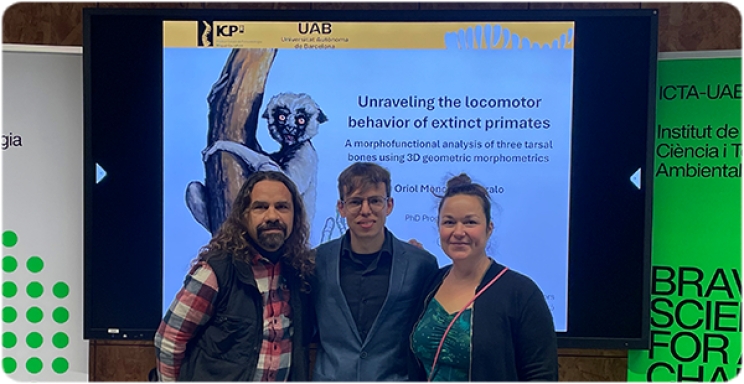
Researcher Oriol Monclús-Gonzalo defended his doctoral thesis on February 23, titled “Unraveling the locomotor behavior of extinct primates: A morphofunctional analysis of three tarsal bones using 3D geometric morphometrics.” Supervised by Judit Marigó and David M. Alba, the research examines the functional morphology of three tarsal bones (the talus, calcaneus, and navicular) in both living and fossil primates.
Combining 3D geometric morphometrics with advanced statistical analyses, the study identifies clear relationships between bone shape and locomotor behavior, enabling more accurate reconstructions of how extinct primates moved.
The thesis is structured around two case studies. The first explores the origin and locomotor diversification of euprimates (modern-looking primates). The second describes a previously unknown fossil dryopithecine astragalus, offering new insights into the locomotor evolution of crown hominoids.
The research has resulted in three peer-reviewed publications in specialized anthropology journals. Among its most significant findings are the strong link between tarsal bone shape and specific locomotor modes, supporting their value for future functional studies; evidence that plesiadapiforms, often considered basal primates, were quadrupeds with diverse locomotor repertoires; indications that early euprimates showed moderate adaptations for leaping, with notable differences between omomyiforms and adapiforms (the latter exhibiting greater locomotor diversity), and the identification of a mosaic of primitive and derived traits in the dryopithecine astragalus compared with crown hominoids, shedding new light on their evolutionary history.
From the Institut Català de Paleontologia, we warmly congratulate him on this achievement and wish him every success in his new stage as a postdoctoral researcher at the University of Cambridge.