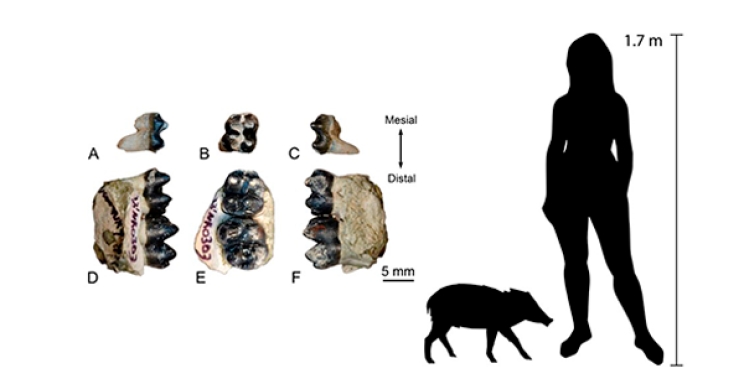
Imagine the savannas of eastern Africa, large animals such as elephants and giraffes are iconic in the background. The star of the show is perhaps a lion chasing a warthog in the foreground. Six million years ago, things were a little different. Imagine a woodland environment, colobus monkeys resting in the trees; mid-sized antelopes like the impala feeding on the undergrowth peacefully. Suddenly, a truly enigmatic animal trots out of the thicket–a mini pig the size of a dog, and quickly disappears into the shadows. All that is left is the ruffling of leaves. Scientists have confirmed the presence of this rare miniature pig named Cainochoerus at Lemudong'o of the southern Kenyan Rift, thanks to new discoveries of fossil jaws and teeth.
In a new study published in the Journal of Vertebrate Paleontology, paleontologists described the fossils that represent the first occurrence of Cainochoerus from this 6-million-year-old site. The find includes an upper deciduous premolar—the first such baby tooth attributed to it in eastern Africa. "Finding Cainochoerus at Lemudong'o was a big surprise" explains Dr. Deming Yang, the lead author of the article at Midwestern University. "Its teeth look like monkey teeth at a glance, and we actually confirmed it two years after bringing it back to the National Museums of Kenya. It took more than a closer look".
Cainochoerus is a unique branch on the pig family tree. While its cousins evolved to be larger, it became remarkably small—a phenomenon that puzzles scientists. "Cainochoerus is much smaller than the pigs we see in Africa today" explains Dr. Yang. “The smallest African pig that we are familiar with is the warthog, which weighs at about 60 kg. Cainochoerus is estimated to be between 5-10 kg, like the size of a small duiker today”. Its monkey-like teeth suggest that Cainochoerus fed on leaves and fruits close to the ground.
Despite being known from several sites across Africa (from South Africa to Kenya) spanning over several million years, Cainochoerus fossils are very rare. Each new specimen could bring a vital clue to its geographic distribution and evolutionary history. The new fossils closely match those found at the Langebaanweg site in South Africa and at Lothagam in northern Kenya. The Lemudong'o discovery adds a new dot on the map, extending its known range into the southern Kenyan Rift. This suggests that Cainochoerus was a widespread mini pig about 7-5 million years ago.
This discovery goes beyond adding one more species to the list. It helps paleontologists understand the composition and connections between ancient African ecosystems. By pinpointing where and when this specialized animal lived, researchers can better ask questions about why it evolved to be so small, what role it played in the food web, and how it responded to climatic changes that swept Africa during the late Neogene—a time when our own ape ancestors were also evolving. "We hope to find more exciting fossils like Cainochoerus in the future" says Dr. Ashley Hammond, a co-author of the article at the Institut Català de Paleontologia Miquel Crusafont (ICP-CERCA). "Critically, any fossils from this timeperiod in Africa provide information about the paleoenvironment during the time when human ancestors were first evolving. They all contribute valuable pieces of the puzzle."
So, the next time you picture an ancient ecosystem in eastern Africa, don't forget the miniature marvels hiding in the bush. Among the herbivore giants and ancient human ancestors, the dog-sized pig Cainochoerus was carving out its own unique niche, a testimony of the incredible and often unexpectedly diverse ecosystem in our planet's past.
By Dr. Deming Yang
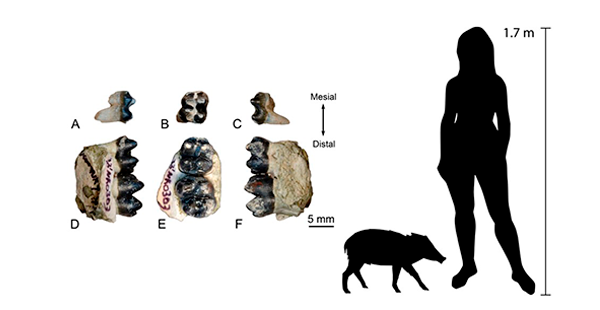
Main image: On the left, fossil teeth and jaw fragments of Cainochoerus from the Lemudong’o Formation in southern Kenya (Yang et al., 2026). On the right, a size comparison in relation to an adult person.
Original article:
-
Yang, D., Manthi, F. K., DiMaggio, E. N., Arenson, J. L., Ambrose, S. H., Souron, A., & Hammond, A. S. (2025). The first occurrence of Cainochoerus (Mammalia, Artiodactyla, Suidae) from the late Miocene Lemudong’o Formation, Kenya. Journal of Vertebrate Paleontology. https://doi.org/10.1080/02724634.2025.2583028