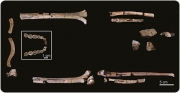
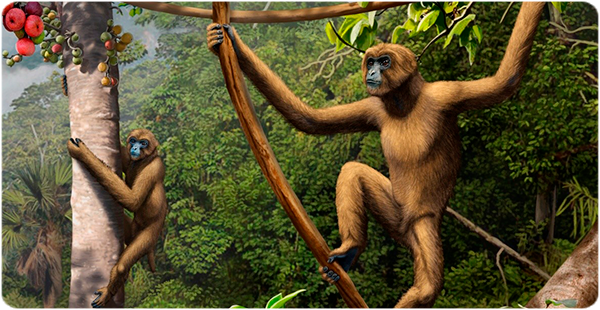
Pliobates was described in 2015 based on a partial skeleton (popularly known as “Laia”) from the site of Abocador de Can Mata (Vallès-Penedès Basin), which is dated to 11.6 Ma. Initially, owing to multiple similarities in the skull and the rest of the skeleton, it was interpreted as a stem hominoid—i.e., predating the split between lesser apes (gibbons and siamangs) and great apes (orangutans, gorillas, and chimpanzees). Subsequently, new dental remains demonstrated that it is a stem catarrhine (predating the divergence between monkeys and apes) that belongs to the extinct group of pliopithecoids. Therefore, the similarities between Pliobates and living apes are currently interpreted as evolutionary convergences (i.e., as having evolved independently).
In the paper, published in the journal iScience, the radius of Pliobates (one of the most complete bones of the partial skeleton) is compared with a very broad sample of extant and fossil catarrhines using three-dimensional geometric morphometric techniques. The analyses provide new insight into the locomotion of Pliobates and the evolution of the elbow in catarrhine primates. Specifically, the Pliobates radius shows a unique combination of primitive and derived features. The articulation between the humerus (the upper arm bone) and the radius is very similar to that of extant apes, indicating a wide range of motion, related to swinging from branches. In contrast, the articulation between the radius and the wrist is much more primitive, similar to that of extant monkeys and other extinct stem catarrhines, as is the elbow articulation between the humerus and the ulna (the other forearm bone). This indicates that Pliobates was not adapted for routinely performing the aforementioned suspensory behaviors (particularly, the agile brachiation displayed by gibbons).
In conclusion, the radius of Pliobates highlights the importance of fossils for understanding how, when, and why the locomotor adaptations of modern hominoids arose. On the one hand, it challenges the preeminent role often attributed to the suspension in ape locomotor evolution. On the other hand, it also demonstrates how readily comparable morphologies may evolve when distinct lineages are subjected to similar selective pressures. This latter point, which poses a challenge for reconstructing the kinship relationships between extinct and extant primates, also guarantees that we can reconstruct quite accurately how these primates moved so many millions of years ago.
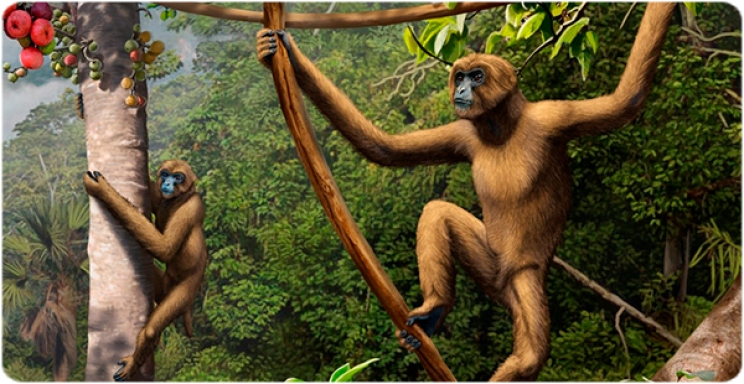
Main image: Life reconstruction of Pliobates cataloniae showing different types of locomotion. Illustration: Jesús Gamarra, © ICP.
Article:
-
Arias-Martorell, J., Raventós-Izard, G., Monclús-Gonzalo, O., Urciuoli, A., Gamarra, J., Nakatsukasa, M., Moyà-Solà, S., & Alba, D. M. (2026). Ape-like locomotor adaptations in the radius of the stem catarrhine Pliobates shed light on hominoid evolution. iScience, 29, 114622. https://doi.org/10.1016/j.isci.2025.114622