In Central Anatolia, a region known for its high altitude and cold winters, the General Directorate of Mineral Research and Exploration of Turkey opened the Dursunlu Lignite Quarry in 1986, abbreviated as DLQ. When excavations began, miners encountered fossil remains of mammals among the clay layers, and a few years later, stone tools carved by hominins. What had begun as a mining project quickly turned into an unprecedented discovery for prehistoric studies: Dursunlu became one of the oldest known Pleistocene sites in Turkey.
The Dursunlu paleolake
During the Early Pleistocene (around 900,000 years ago), this place hosted a shallow lake with dense vegetation along its shores and a great diversity of aquatic organisms. This environment developed over Miocene sediments, later covered by layers of lignite, clay, and Pleistocene marls.
During the Pleistocene, especially the glacial periods, this area of Turkey—located at about 1,000 meters above sea level—experienced winters significantly colder than today. Paleoclimatic models show that average temperatures could be 10 to 15 °C lower than current ones. This raised a question: how did the first hominins survive and thrive under such conditions? Studying the fossil animals and plants that lived in this area provides some clues to answer this question.
Despite harsh winters, the fauna and flora of the site also reveal abundant precipitation and high humidity during the Pleistocene. This would have allowed the development of remarkable biodiversity adapted to strongly fluctuating environments.
The first findings in Dursunlu date back to the last century. In the 1980s, miners had already found remains of large mammals such as proboscideans, artiodactyls, perissodactyls, and carnivores. Shortly after, detailed analysis of tons of sediment also yielded small mammals, such as insectivores, rabbits, and rodents. The 1993 and 1994 field campaigns further expanded the fossil record with remains of reptiles, amphibians, birds, and fish, consolidating Dursunlu as a site of great value for understanding Early Pleistocene biodiversity.
Paleontological studies at the DLQ site received a significant boost when several fragments of mammal bones associated with stone tools were discovered. This finding not only confirmed the presence of hominins in the area but also became the oldest evidence of human presence in present-day Turkey. In the following years, the importance of the site grew even more thanks to the recovery of over 100 modified stone tools—many of them manufactured using the bipolar technique on quartz—accompanied by bones with cut marks indicating meat processing carried out by hominins.
With the help of fossils
Now, for the first time, a detailed taxonomic study has been carried out on several flora and fauna groups that coexisted with the hominin populations. The Institut Català de Paleontologia (ICP-CERCA), the University of Barcelona and the Hacettepe University of Türkiye, have recently published this study in the journal Diversity, which provides a more complete view of the paleoenvironment of this setting based on the analysis of six samples.
To understand what the Dursunlu lake was like, it is important to know how fossils help us reconstruct ancient landscapes. If we find, for example, the fossil of a snail that today lives in shallow, calm waters, we can deduce that hundreds of thousands of years ago that place had similar characteristics.
When fossils of aquatic plants—represented by three species of the genus Chara—as well as seeds of Najas marina and Zannichellia palustris were analyzed, researchers concluded that the lake was shallow and rich in vegetation. These plants, with thin and flexible leaves and still existing today, grow submerged in freshwater or slightly brackish shallow waters.
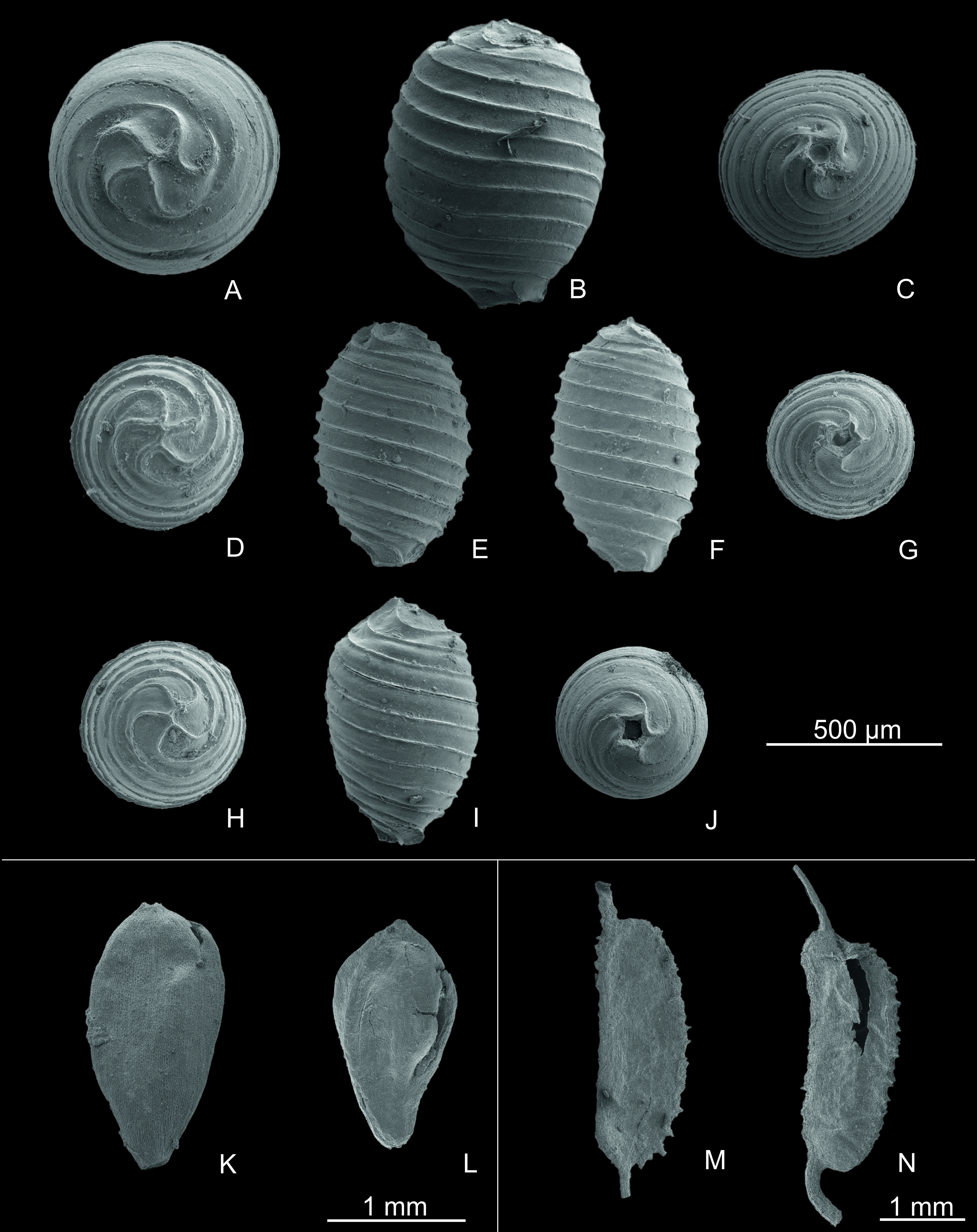
Aquatic plant remains from the fossil lake of Dursunlu. The calcified capsules containing the spores of the algae Chara (photos A–J) and the seeds of Najas marina and Zannichellia palustris (photos K–N), indicate shallow waters.
The presence of freshwater snail fossils, which prefer minimal water flow, and high levels of organic matter suggest nutrient-rich and calm waters. However, remains of fish requiring at least some water movement were also found, indicating that the lake was not an isolated pond but rather a system connected to rivers and streams that refreshed its waters.
The study of small crustaceans (called ostracods) provided further information. Species adapted to saline waters indicate that in the oldest sediment layers, the water was slightly salty. In contrast, freshwater ostracods were found in more recent sediments, signaling a shift toward less saline waters.
Finally, remains of monkeys, toads, and fragments of turtles, lizards, and water snakes describe very shallow shores with abundant vegetation. These environments, with waterlogged soils and peatlands, offered ideal habitats for the proliferation of herpetofauna.
An oasis for hominins
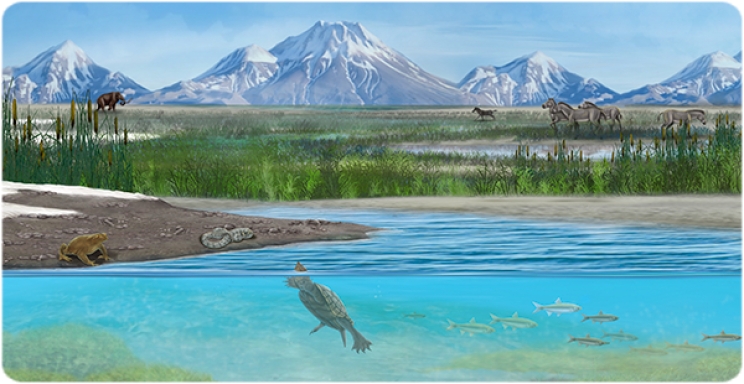
Based on this study, we can imagine the Dursunlu paleolake as a shallow lake with vegetation at its shores, fish swimming rapidly in the water, and toads and snakes thriving in the surrounding peat. This rich environment, surrounded by a steppe landscape subjected to glacial winters, provided food and easy access to water for the first hominins who—perhaps only sporadically—settled there, taking advantage of resources such as fishing and possibly hunting amphibians and reptiles when larger prey was scarce.
However, the lake was not a static environment. Over time, its conditions varied, including periods with less water in which the landscape resembled a marsh. The paleoenvironmental reconstruction of this ancient lake is a good example of how life adapts to its surroundings and how the study of animal and plant remains allows us to explain its history hundreds of thousands of years later.
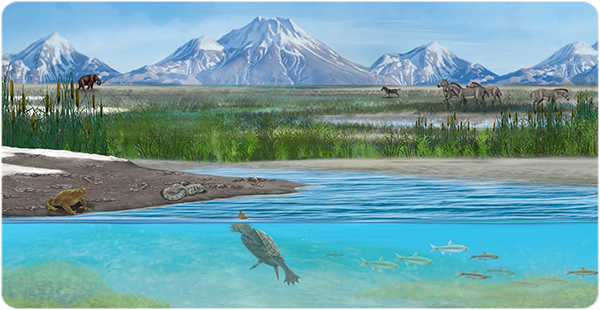
Main image: Recreation of the most relevant flora and fauna from the Early Pleistocene site of the Dursunlu Lignite Quarry. Illustration by Roc Oliveras (Catalan Institute of Paleontology Miquel Crusafont / FECYT).
Original article:
Luján, À. H., Paclík, V., Demirci, E., Villa, A., Neubauer, T. A., Tuncer, A., Ivanov, M., Blanco-Lapaz, À., Vega-Pagán, K. A., & Sanjuan, J. (2025). An Integrated Paleoenvironmental Reconstruction of the Early Pleistocene Hominin-Bearing Site of Dursunlu (Türkiye). Diversity, 17, 631. https://doi.org/10.3390/d17090631