Australia’s geographic isolation from the rest of the continents, approximately 45 million years ago, triggered the emergence and diversification of a unique fauna on Earth. But what was life like just before this separation?
An international team, led by the Institut Català de paleontologia Miquel Crusafont (ICP-CERCA) and with participation from the University of New South Wales (UNSW Sydney), has described the oldest crocodile eggshells ever found in Australia. These fossils provide a better understanding of Australian ecosystems a few million years before the continent became isolated.
The new fossils, named Wakkaoolithus godthelpi, most likely belonged to mekosuchine crocodiles, an extinct and endemic lineage that dominated most of the continent’s ecosystems around 55 million years ago.
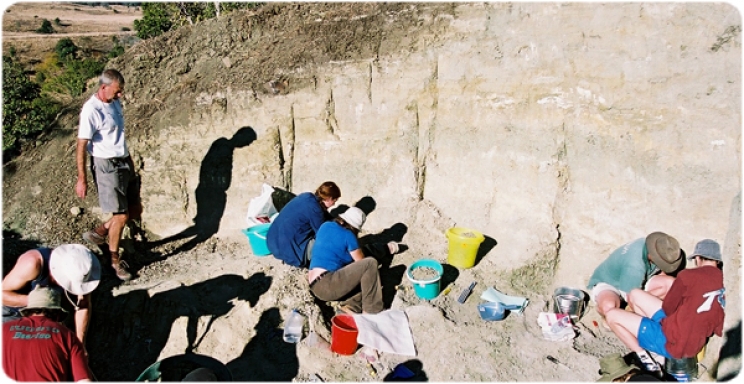
The eggshells were discovered over ten years ago in Murgon, Queensland, at one of the continent’s oldest Cenozoic fossil sites. What now appears as a modest clay pit is in fact a unique window into a time when Australia was still connected to Antarctica and South America.
Murgon’s lake was surrounded by a tropical forest with remarkable fauna: the oldest known songbirds, the first Australian frogs and snakes, small mammals, and some of the world’s oldest bats.
“These eggshells offer a new perspective on mekosuchine reproductive biology,” explains Xavier Panadès i Blas, a predoctoral researcher at the ICP and lead author of the study. “We can now begin to understand not only their anatomy but also how they reproduced and adapted to changing environments.”
The name Wakkaoolithus godthelpi honors the Australian First Nations people Wakka Wakka, the traditional custodians of the territory where the fossils were found, and Henk Godthelp, a historic member of the UNSW paleontology team.
A microscopic witness of the past
Microscopic and electron analyses reveal that these crocodiles laid their eggs along the edges of temporary lakes, a reproductive strategy adapted to fluctuating environmental conditions.
According to Panadès i Blas, eggshells remain a largely untapped source of paleontological information:
“They preserve microscopic and geochemical signals that can tell us not only which animal laid them, but also where and how it reproduced. They should be considered a standard element of any paleontological excavation, alongside bones and teeth.”
In addition to the mekosuchine crocodile eggshells, the Murgon site has yielded dozens of bird eggshells, which are currently under study by the same team. These findings will provide valuable insights into the avian faunas that inhabited Australia just before its final isolation from the rest of the continents.
Main image: UNSW paleontologists excavating the Tingamarra fossil site, Murgon (Queensland, Australia). The compact clay is extracted, left to dry, and then soaked to release the fossils it contains. Photo: Mina Bassarova.
Article reference:
- Panadès i Blas, X., Archer, M., Stein, M., Hand, S., Godthelp, H., et al. (2025). Australia’s oldest crocodylian eggshell: insights into the reproductive paleoecology of mekosuchines. Journal of Vertebrate Paleontology. https://doi.org/10.1080/02724634.2025.2560010