Accurately placing extinct species in the tree of life remains one of the most persistent challenges in paleontology and evolutionary biology. Unlike living species, fossils rarely preserve genetic material and are often fragmentary, which limits the tools available for reconstructing their evolutionary relationships. To address this gap, an international team of researchers has developed PlaceMyFossils, a new computational tool designed to analyze and visualize the most likely placement of fossils within existing phylogenetic trees.
Published in the journal Systematic Biology, the tool is designed to work with morphological datasets and trees derived from either molecular or morphological data. Through an integrative and comparative approach, PlaceMyFossils not only calculates the most probable position for a fossil within a reference tree but also quantifies the confidence of this placement, identifies the morphological features supporting each location, and evaluates how results vary under different analytical settings. This allows researchers to make better-informed decisions when interpreting phylogenetic outcomes, particularly in scenarios where data are limited or ambiguous.
PlaceMyFossils is implemented as an interactive script within TNT (Tree Analysis Using New Technologies), a widely used software for morphological phylogenetic analysis. In contrast to previous tools, it supports discrete, continuous, and geometric morphometric data; accommodates multiple optimality criteria such as maximum parsimony and likelihood; and generates publication-ready graphical outputs. One of its key innovations is the ability to evaluate the behavior of character partitions (e.g., different anatomical regions), apply leave-one-out validation procedures, and assess placement error both globally and across different parts of the reference tree. These features help develop more robust evolutionary inferences based on the results.
 PlaceMyFossils workflow. Starting from a morphological dataset (query) and a reference tree, the TNT script performs a series of analyses—fossil placement, comparison of optimality criteria, character-partition assessments, sensitivity tests, leave-one-out validations, and global/subtree error calculations—and outputs the results as publication-ready graphics (SVG), tables (TXT), and tree files (TNT/Jplace).
The researchers applied PlaceMyFossils to two empirical case studies to demonstrate its performance. In the first, they assessed the placement of Agathis immortalis, an Eocene fossil conifer from Patagonia, using a molecular-based reference tree and a morphological dataset. The analysis identified a clear position at the base of the genus Agathis, with strong support from cone-related characters and very low placement error. In the second case, they examined Nyasasaurus parringtoni, potentially one of the earliest known dinosaurs, based on a few vertebrae and a single humerus. The tool suggested a likely placement within Sauropodomorpha, while also revealing significant uncertainties driven by the sparse anatomical data—particularly in the hindlimb. This nuanced outcome highlights PlaceMyFossils' utility in disentangling sources of ambiguity and testing the robustness of different phylogenetic hypotheses.
Among the authors of the study is Sergio Almécija, an associate researcher (and future ICREA Research Professor) at the Institut Català de Paleontologia Miquel Crusafont (ICP-CERCA) and a member of the Department of Anthropology at the American Museum of Natural History (AMNH) in New York. Almécija contributed his expertise in morphometrics, paleontology and evolution to the development and validation of the tool. As he explains, "PlaceMyFossils offers a novel and straightforward way to integrate fossil evidence into evolutionary trees with greater transparency and methodological rigor. The tool is especially useful when working with species for which we only have partial and fragmentary morphological data available, like many fossil primates."
The full list of authors includes Santiago A. Catalano (Universidad Nacional de Tucumán, CONICET – Fundación Miguel Lillo, AMNH), Ignacio Escapa (Museo Paleontológico Egidio Feruglio, CONICET), Kelsey D. Pugh (research associate at the ICP), Ashley S. Hammond (AMNH), Pablo Goloboff (CONICET – Fundación Miguel Lillo), and Sergio Almécija (AMNH, ICP-CERCA).
The project was supported by the Agencia Nacional de Promoción Científica y Técnica (Argentina), the Consejo Nacional de Investigaciones Científicas y Técnicas (CONICET), the Spanish Ministry of Science and Innovation through the Agencia Estatal de Investigación (AEI), and the Generalitat de Catalunya through the CERCA Programme.
Both the article and the tool are open access. The full publication is available in Systematic Biology, and the script—along with its user guide and example datasets—can be downloaded from GitHub:
- https://academic.oup.com/sysbio/advance-article/doi/10.1093/sysbio/syaf025/8115461
- https://github.com/sacatalano/PlaceMyFossils
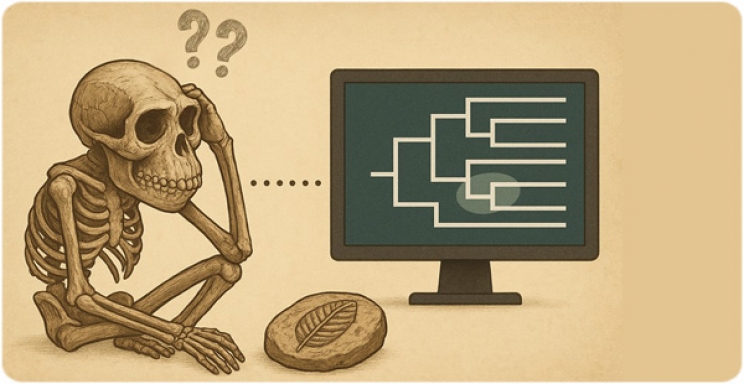
Main image: AI generated image:Primate skeleton scratching its head, pondering the placement of a fossil in a phylogenetic tree.
Research article:
- Catalano, S. A., Escapa, I., Pugh, K. D., Hammond, A. S., Goloboff, P., & Almécija, S. (2025, published online). PlaceMyFossils: An Integrative Approach to Analyze and Visualize the Phylogenetic Placement of Fossils Using Backbone Trees. Systematic Biology. https://doi.org/10.1093/sysbio/syaf025