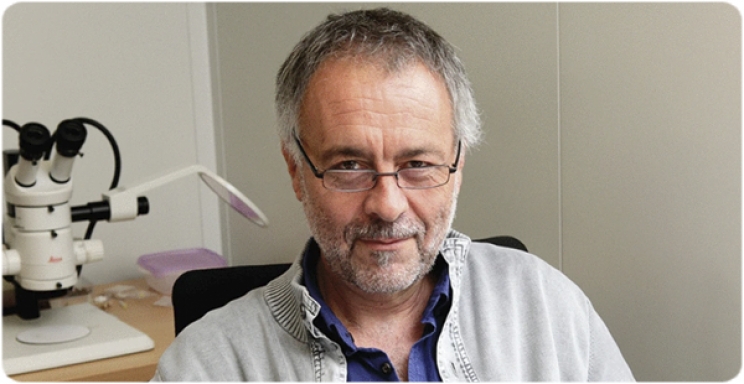
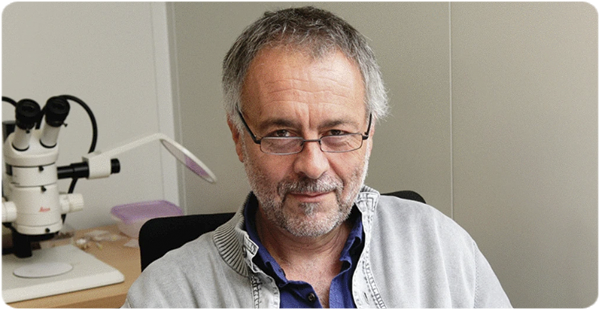
When Salvador Moyà-Solà came from Mallorca to Catalonia, he has the clear goal of becoming a vertebrate paleontologist. And no one can deny that he succeeded by far. Even before finishing his degree, he was already involved in paleontological research, focusing especially on the study of island faunas. Later on, a somewhat unexpected twist, he met Miquel Crusafont—the father of vertebrate paleontology in Catalonia—, who supervised Moyà-Solà’s bachelor’s thesis. However, Crusafont’s illness prevented him from supervising Moyà-Solà’s doctoral thesis on fossil bovids, which he completed in 1983—the same year Crusafont passed away. Soon after, Moyà-Solà become tenured secured a position at the at the former Institut de Paleontologia M. Crusafont in Sabadell at a time when vertebrate paleontology in Catalonia was underfunded and largely isolated from the universities.
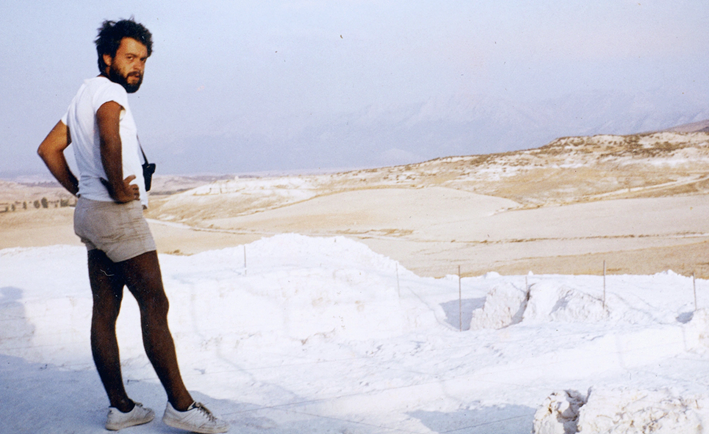
Salvador Moyà-Solà in the field in the early 1980s at Venta Micena. Photograph: courtesy of Jorge Morales
Characterized by a strong determination, in the late 1980s Moyà-Solà set ambitious goals for his subsequent career and, deliberately chose to become a paleoprimatologist—influenced by his previous discoveries of Miocene apes in the field and the void left by Crusafont. Within a decade he had succeeded in his goal: his extraordinary discoveries of Miocene hominoids in the Vallès-Penedès basin and elsewhere, along with other high-impact (and provocative) contributions on the island anthropoid Oreopithecus, established him as a leading figure in the field, earning widespread recognition.
Despite this turn toward paleoanthropology, Moyà-Solà did not neglect the study of mammals from other groups and time intervals. In fact, he never considered paleoanthropology to be a distinct discipline from vertebrate paleontology—in agreement with the European tradition in this regard. As a result, he was kind of an outsider to paleoanthropology. This, coupled with his tendency to think big, led him to favor some controversial hypotheses about Miocene apes.
Paleontologist by vocation despite his geological academic background, he always promoted a paleobiological approach to vertebrate paleontology. He strongly advocated that paleobiology, thanks to its access to deep time, has a voice of its own among life sciences with regard to evolution. His interest went beyond the evolutionary history of particular groups, extending to the mechanisms and selection pressures involved. Moyà-Solà is a worthy disciple of Miquel Crusafont, in the sense of sharing the conviction that paleontology and evolution form an inextricable binomial.
Decisive Drive at the ICP
During the 2000s, his career was strongly influenced by the discovery and description of Pierolapithecus—which, coupled with his charisma, enthusiasm, and strong determination—made it possible the refoundation of the IPMC into the current ICP as a CERCA center. This allowed him to establish, as an ICREA research professor, to establish two research groups: Paleoprimatology & Human Paleontology plus Neogene & Quaternary Faunas, reaching the peak of his scientific production in the early 2010s.
As a group leader, Moyà-Solà proved good fundraising abilities and a keen eye for talent recognition, and showed an enormous generosity in terms of fossils, sites, research topics, and the like. In his role as a supervisor he took a non-invasive approach and acted more as a mentor, by providing young PhD students and postdoctoral researchers with the necessary opportunities and means to succeed (or fail) on their own. This approach allowed many of them to eventually become independent researchers.
During his tenure as director of the ICP (2006–2017), he had to assume the associated burden of executive responsibilities and problems. These difficulties intensified during the second half of his direction, marked by the struggle to keep the center afloat amid the budgetary cuts caused by a global financial crisis. Nevertheless, Moyà-Solà succeeded overcame these challenges, while maintaining high levels of scientific output, and even securing a new building for the ICP. After more than a decade as director, he voluntarily resigned from the role, and has remained active as a research group leader ever since.
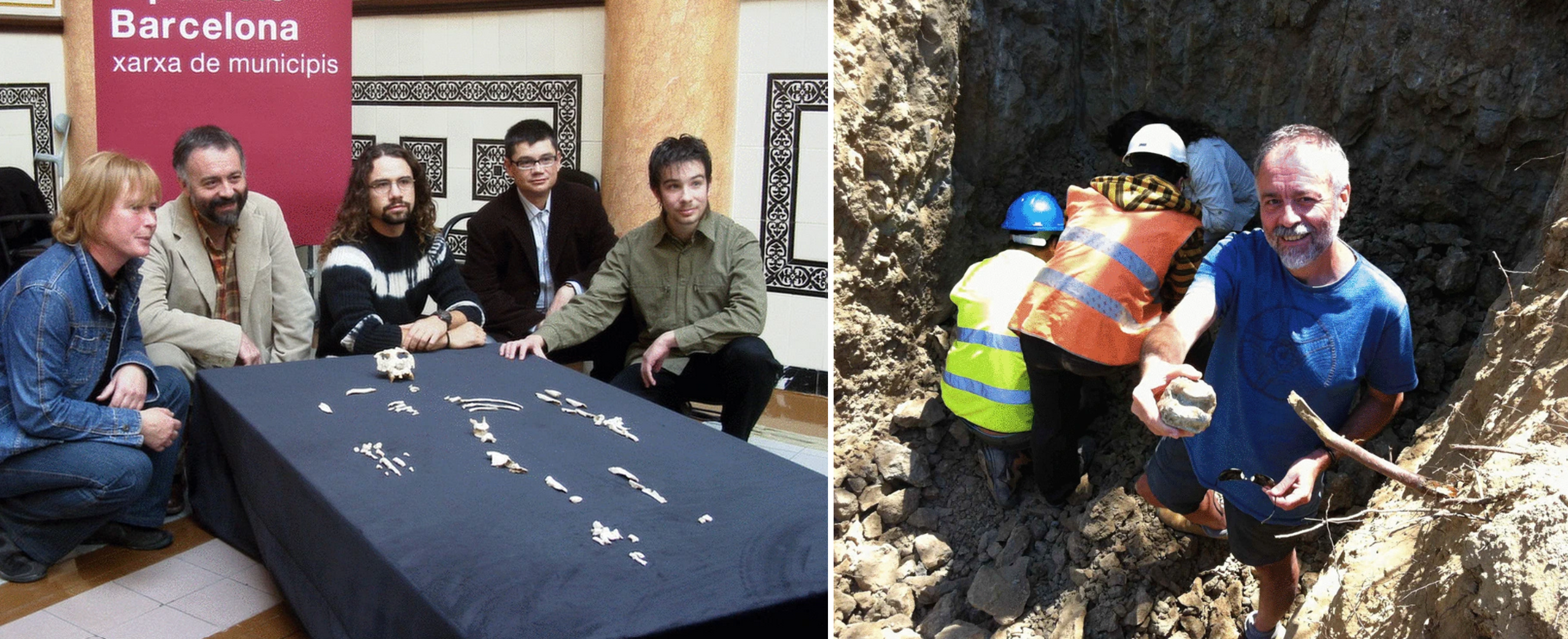
To the left, press conference about the publication of Pierolapithecus at the Escola Industrial de Barcelona on November 18, 2004. To the right, Salvador Moyà-Solà during fieldwork holding a newly recovered deinothere molar. Photographs: ICP / Sergio Almécija.
The Legacy of Moyà-Solà
Moyà-Solà’s scientific production, recognized with numerous awards and honors, is mostly devoted to Cenozoic and Quaternary mammals, with emphasis on the faunas from Mediterranean paleoislands and, especially, fossil primates from the Eocene and Miocene. In the course of his research trajectory, he established multiple new mammal genera and species, and described innumerable fossils, often recovered through his own fieldwork efforts. His remarkable luck with fossil primate discoveries is legendary, but should not hinder the recognition of his keen eye for the study of fossils, his hard work, and his talent in identifying hot research topics.
The fossils he excavated will remain housed in the ICP for the next generations. The taxa that he described will make a long-lasting contribution to mammal systematics, and his seminal publications on Miocene primates, insular mammals, and other topics will surely be cited for many years to come Yet his legacy extends far beyond his scientific output: the establishment of the ICP not only benefited him own team, but also provided the suitable conditions for new generations of vertebrate paleontology researchers to flourish in Catalonia.
The timely discovery of Pierolapithecus was a cosmic fluke that could not repeat in a million years. But the ability to seize that opportunity to advance the Catalan school of vertebrate paleontology is an indisputable merit of Salvador Moyà-Solà. The time and energy devoted to the direction of the ICP, while simultaneously leading a research group, is an incommensurable effort. Yet, given the subsequent consolidation of the ICP in recent years, there can be no doubt that all these sacrifices were valuable and well invested. Moreover, just like Crusafont is considered the father of vertebrate paleontology in Catalonia, there would be no Catalan school of paleoprimatology without Moyà-Solà.
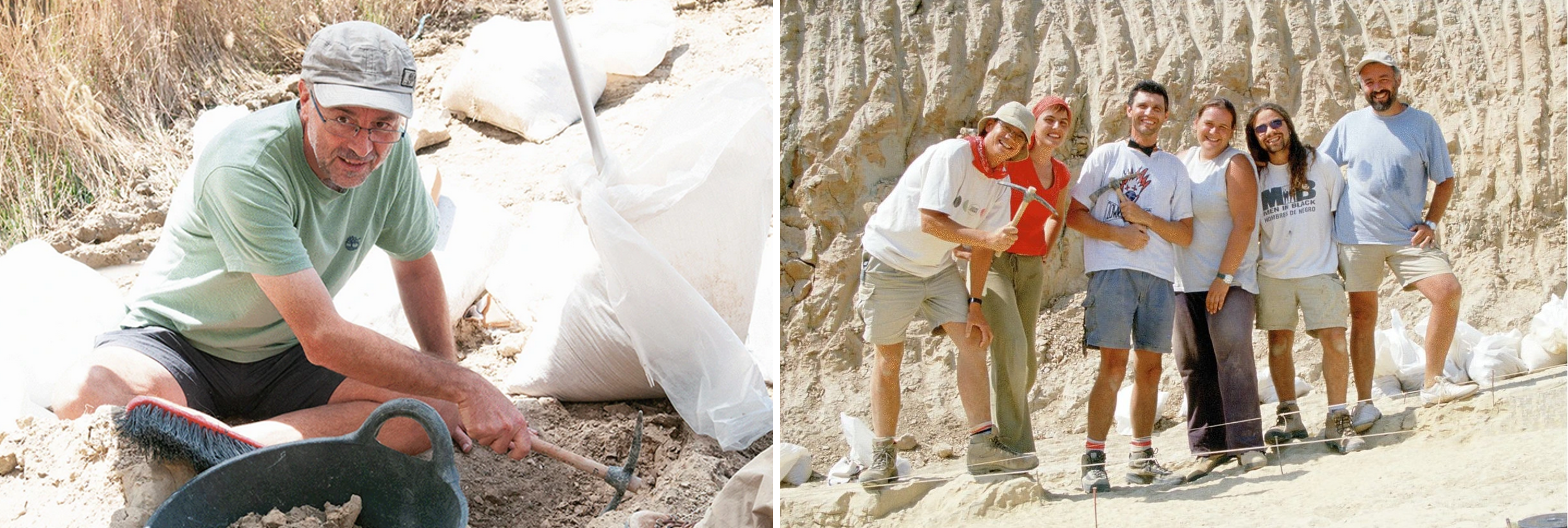
To the left, Salvador Moyà-Solà excavating on July 3, 2012. To the right, part of the excavation team in early July 2003 (from left to right: Jordi Galindo, Begoña Poza, Checa, Cheyenn Rotgers, David M. Alba, and Moyà-Solà). Photographs: David M. Alba / Salvador Moyà-Solà.
After five decades of active research activity, Prof. Moyà-Solà is forced to retire at the age of 70 years-old. Nevertheless, since he will remain affiliated with the ICP as an researcher emeritus, another generation of young students will continue to benefit from his expertise in primates, artiodactyls, and other mammals.
From the ICP, we would like to sincerely thank him for his courage and leadership during a key stage of paleontology in our country. We wish him all the best in this new phase of his life, in which he will be able to pursue his research interests while enjoying family and the freedom of being devoid of professional burdens. He most certainly earned it. Crusafont sowed the seed and watered the seedling, but it was Moyà-Solà who, four decades later, made the tree grow taller and stouter until it flourished. So, let’s all do our best to honor this legacy by ensuring the ICP keeps blooming in years to come.
Main image: Salvador Moyà-Solà in his office. Photograph: Jordi Pareto.
For further reading:
- Alba, D. M. (2025). Research trajectory, works, and legacy of Salvador Moyà-Solà as a vertebrate paleobiologist. Journal of Mammalian Evolution, 32, 24. https://doi.org/10.1007/s10914-025-09760-9