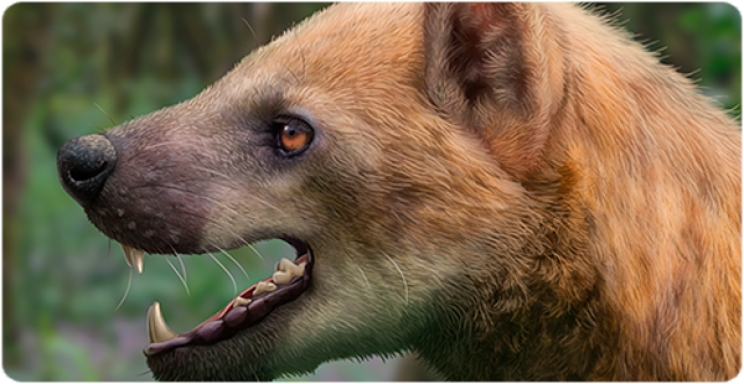

The amphicyonids —colloquially known as "bear-dogs"— were a group of carnivores that flourished in North America and Eurasia during much of the Cenozoic, from the Eocene to the late Miocene. Despite their popular name, they are not directly related to either modern dogs or bears, but instead constitute an extinct family within the order Carnivora. They exhibited a wide variety of sizes and dental adaptations, ranging from hypocarnivorous species —with crushing dentition, convergent with that of ursids, and a meat percentage of less than 30% in their diet— to hypercarnivorous forms (more than 70%) with a felid-like dentition.
Paludocyon moyasolai belongs to the subfamily Amphicyoninae and is placed within the genus Paludocyon, described in 2011 by Jorge Morales and his team to include species that until then had been classified within the genus Cynelos. Species of Paludocyon are characterized by maintaining a relatively hypercarnivorous dentition, with robust upper molars and reduced premolars.
The type material —the one used to erect the new species— includes a fairly complete but laterally crushed skull with an almost complete upper dentition and an isolated second lower molar. The analysis of the upper dentition morphology has allowed the identification of features that distinguish P. moyasolai from all other known species of the genus. In particular, it presents unique proportions of the upper molars and a more developed third molar with well-defined anterior cusps. These characters have not been observed in any other species of Paludocyon.
![Type specimen of Paludocyon moyasolai sp. nov. recovered at the Els Casots site (Subirats). (extracted from Morales, J. et al., 2026).]](/images/noticies/2026/crani_paludocyon_web.jpg "Type specimen of Paludocyon moyasolai sp. nov. recovered at the Els Casots site (Subirats). (extracted from Morales, J. et al., 2026).]")
Type specimen of Paludocyon moyasolai sp. nov. recovered at the Els Casots site (Subirats). (extracted from Morales, J. et al., 2026).]
Paludocyon was likely a fast, medium-sized hunter, considerably smaller and more agile than a second amphicyonid species the size of a leopard that inhabited the Els Casots site and has not yet been described. Other carnivores from the site include primitive felines, large-sized mustelids, and small crocodiles of the genus Diplocyonodon. Paludocyon probably hunted small to medium-sized herbivores, such as certain deer, bovids, and small suids.
The Els Casots site, a window into the Catalan Miocene
Els Casots is one of the reference Miocene vertebrate sites in southeastern Europe. The age of the site, estimated at around 15.9 million years, is based on a combination of biostratigraphic and magnetostratigraphic data. Located on the southern margin of the Vallès-Penedès basin, it was discovered in 1989 and was subject to excavations until 1994. Systematic campaigns were resumed in 2018 and have continued uninterruptedly since then. To date, more than 5,000 macrovertebrate remains have been recovered, representing nearly 80 species of vertebrates, including fish, amphibians, reptiles, birds, and mammals.
The fauna, flora, and sedimentology of the site indicate that it was a shallow freshwater lake very close to the coast, within a context of warm conditions associated with the Miocene Climatic Optimum. In fact, Paludocyon means 'swamp dog'.
A tribute to Salvador Moyà-Solà
The new species is named after Salvador Moyà-Solà (Palma de Mallorca, 1955), one of the most influential figures in European vertebrate paleontology in recent decades. Holding a degree in Geology from the Universitat Autònoma de Barcelona and a PhD from the same institution, Moyà-Solà continued his scientific career at the Institut de Paleontologia de Sabadell. In 2006, he was appointed an ICREA research professor and played a decisive role in the creation of the Institut Català de Paleontologia Miquel Crusafont, which he directed from its foundation until 2017. He is currently an emeritus researcher at the ICP.
Moyà-Solà's connection to this discovery goes far beyond the nominal tribute, as the renowned paleontologist was one of the architects of the first excavation campaigns at Els Casots. Following the discovery of the site in 1989, Moyà-Solà promoted the first systematic excavation campaigns that took place until 1994. The fossil remains of the skull that have allowed the description of the new species Paludocyon moyasolai were recovered precisely during these early interventions, specifically in the year 1991.
The dedication of Paludocyon moyasolai represents, in the words of the article's authors, a recognition of Moyà-Solà's «wonderful contribution to the development of European paleomammalogy.»
Research team and funding
Research personnel from several institutions participated in the study. On behalf of the ICP, contributions were made by Jesús Gamarra, Josep Robles, David M. Alba, Isaac Casanovas-Vilar, and Juan Abella (Universitat de València and associated with the ICP). The rest of the research team is composed of Jorge Morales (Museo Nacional de Ciencias Naturales-CSIC), Alberto Valenciano (Universidad Complutense de Madrid / Iziko Museums of South Africa), and Maria Gregori (Instituto Nacional de Biodiversidad of Ecuador / Universitat de València).
The study was funded through various R&D&I projects from the State Research Agency of the Ministry of Science and Innovation of Spain. Likewise, the research received support from the CERCA Program and the Agència de Gestió d'Ajuts Universitaris i de Recerca (AGAUR) of the Generalitat de Catalunya. Finally, the fieldwork and interventions at Els Casots received funding from the Departament de Cultura of the Generalitat de Catalunya, a Leonardo Fellowship from the BBVA Foundation, and the Ajuntament de Subirats, the latter being also involved in the protection of the site and the dissemination of its heritage.
Main image: Recreation of the life appearance of the head and neck of Paludocyon moyasolai sp. nov. Illustration: Jesús Gamarra / ICP
Original article:
- Morales, J., Abella, J., Valenciano, A., Gamarra, J., Robles, J. M., Gregori, M., Alba, D. M., & Casanovas-Vilar, I. (2026). A new species of Paludocyon (Carnivora: Amphicyonidae) from the early Middle Miocene of els Casots (Vallès-Penedès Basin, Barcelona, Spain). Journal of Mammalian Evolution, 33, 29. https://doi.org/10.1007/s10914-026-09814-6