
During the Middle and Late Miocene —between 13 and 11 million years ago— the global climate became drier and cooler. The dense tropical forests of the Vallès-Penedès were fragmented, giving way to more open landscapes, with savannas and shrublands. In this changing environment, primates, deer, giant turtles and small mammals coexisted, as well as a wide variety of birds. In this context, the Abocador de Can Mata (in els Hostalets de Pierola) offers an exceptional geological sequence that covers about 1.5 million years, and allows reconstructing in detail how the fauna and the environment changed during the Miocene.
We have analyzed more than 350 shell fragments and fifteen complete eggs, using microscopy and digital modeling techniques. The eggshells showed a microstructure typical of phasianids (Phasianidae), the family that includes today’s partridges and pheasants. Based on egg size, the team identified at least two potential egg-laying species: one corresponding to Palaeortyx gallica, a small Miocene partridge, and another, slightly larger, Palaeortyx phasianoides. Both were ground-dwelling birds that built their nests on the ground and thrived in open or sparsely vegetated habitats

Some of the phasianid eggs discovered at the Miocene site of Abocador de Can Mata housed at the Museu de l’Institut Català de Paleontologia Miquel Crusafont. © ICP
The most striking aspect of the discovery is its temporal pattern. The eggs appear at several levels of the site, indicating that the same bird species returned repeatedly to the same nesting area for over a million years. This behavior, known as philopatry—the tendency to reproduce in the place of origin—is common among modern birds but rarely documented in the fossil record. Furthermore, the best-preserved eggs come from the uppermost layers of the sequence, dated to around 11.7 million years ago, when the Can Mata landscape became drier and more fragmented. Rather than hindering these birds, such changes may have provided new nesting opportunities in open environments.
While other Miocene species, such as primates, disappeared from the region as forests vanished, the birds of Can Mata displayed remarkable ecological resilience. Their adaptability and high reproductive capacity allowed them to thrive in an ever-changing world. Our study not only identifies who laid these eggs but also sheds light on how these birds lived and behaved more than 11 million years ago. We now plan to compare our findings with other European Miocene sites to determine whether this nest fidelity was a local phenomenon or a widespread reproductive strategy among ancient phasianids.
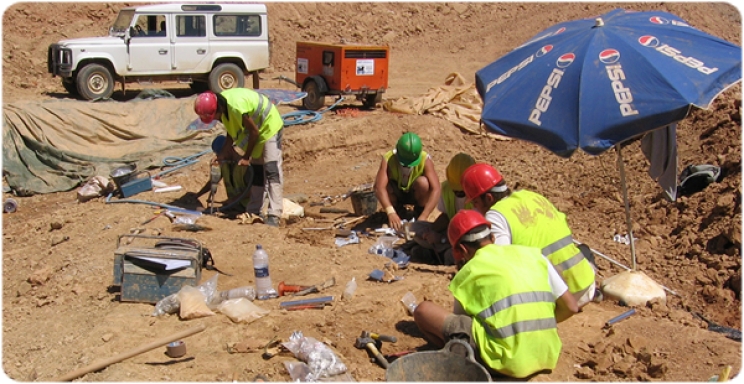
Main image: Paleontologica excavation at the Abocador de Can Mata (ICP)
Dissemination article originally published in UAB Divulga by Albert Sellès and David M. Alba
Original research article:
- Sellés, A. G., Luján, À. H., Casanovas-Vilar, I., Sánchez Marco, A., Robles, J. M., & Alba, D. M. (2025). Exceptionally preserved eggs show philopatric resilience of phasianids against environmental fragmentation throughout the Middle-Late Miocene transition in NE Iberian Peninsula. Papers in Palaeontology, 11, e70060. https://doi.org/10.1002/spp2.70060