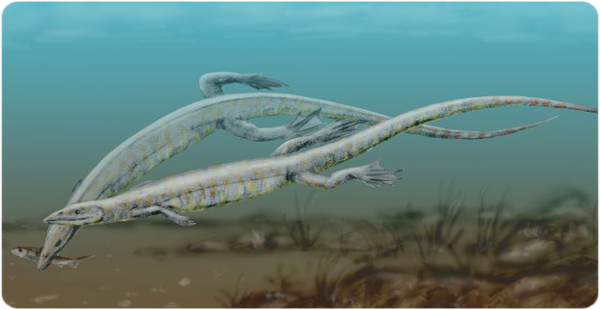
An international team of paleontologists has described for the first time a post-hatchling Pleurosaurus, a marine reptile that lived approximately 150 million years ago during the Jurassic period. The fossil was found in the Mörnsheim Formation in Bavaria, Germany, and offers new insights into how these ancient reptiles grew and developed. Pleurosaurus belonged to a group of marine reptiles distantly related to modern tuataras, animals from New Zealand that are the last surviving rhynchocephalians.
This fossil is particularly interesting because it clearly shows characteristics of a young animal. Its teeth are small and show no signs of wear, the bones are not fully developed, and the vertebrae are still in the process of forming. Its small size, along with other features, makes it the first clearly identified juvenile Pleurosaurus specimen, filling an important gap in the understanding of the growth and development of these extinct reptiles.
The identification of a young Pleurosaurus may also have significant implications for the classification of another genus, Acrosaurus. In the past, some paleontologists suggested that Acrosaurus might represent a juvenile Pleurosaurus, but until now, there was no solid evidence to support this hypothesis. The new fossil shows many similarities to those previously attributed to Acrosaurus, suggesting that the latter may not be a separate genus but simply a hatchling of Pleurosaurus.
“For years we tried to understand how these animals grew and developed, but we had never found such a young and well-preserved specimen.” – Andrea Villa, ‘Beatriu de Pinós’ researcher at the Institut Català de Paleontologia Miquel Crusafont.
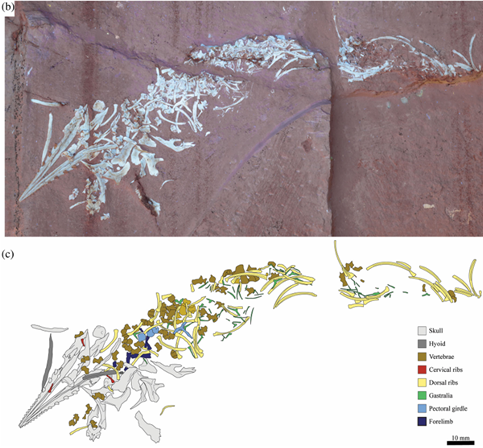
Fossil of the Pleurosaurus hatchling and interpretation (adapted from Beccari et al, 2024).
The Mörnsheim Formation, located near the famous fossil site of Solnhofen, is known for the extraordinary preservation of marine fossils. However, finding a young Pleurosaurus is an extremely rare event: most of the fossils discovered belong to adult specimens.
The new study, published in the journal The Anatomical Record, is the result of collaboration between scientific institutions from Germany, Spain, and the United Kingdom. It was funded by the Deutsche Forschungsgemeinschaft (DFG), the Alexander von Humboldt Foundation, the Generalitat de Catalunya through the CERCA Programme.
Main image: Life reconstruction of two Pleurosaurus goldfussi, a sphenodontian from the Late Jurassic of Germany and France. (© N. Tamura).
Original article:
Beccari, V., Villa, A., Jones, M. E. H., Ferreira, G. S., Glaw, F., & Rauhut, O. W. M. (2025). A juvenile pleurosaurid (Lepidosauria: Rhynchocephalia) from the Tithonian of the Mörnsheim Formation, Germany. The Anatomical Record, 308, 844-867. https://doi.org/10.1002/ar.25545